

Core Of Emergence In Game Design
Tools for Creating Emergence in Narrative and Game Design
Emergence in games could be roughly described as when two separate elements interact with each other to create a dynamic response. I won't go over explaining the concept in detail because other smarter, much more experienced designers have already talked about it extensively (I'll add a bunch of links at the end of the article), but I will assume you're at least familiar with the general idea.
Instead, I want to talk about how certain existing tools and technologies are susceptible to emergence and despite some of them may already be used, you could argue that perhaps not to its full potential. But before that, it's inevitable that if we want to talk about emergence, we need to talk about immersive sims first.
Immersive simulations (or "imsims" for the sake of brevity) are a design philosophy created in the early 90s by Looking Glass Studios (LGS), that to put it briefly, attempted to develop a method for creating player-driven emergence as a core aspect of the design on many of their games. Emergence by itself precedes this, of course, but LGS wanted to focus and push the concept as much as possible. If you want a more elaborate explanation on it and are also interested in the history of LGS, you should listen to the fascinating podcast linked at the end where you can hear it from the developers themselves. Because of this I won't go there too much myself, this is just for a bit of context.
Immersive sim is an illusive concept. It seems there's as many ways to define imsims as there are people. Some take a more narrow meaning with specific requirements like systems or agency, while others go for a more nebulous definition -and frankly too reliant in subjectivity to be of much use- like games that immerse you in a living, believable world. None of these things are necessarily false but they're not specific individual elements working together to form a greater whole, they're all describing the potential consequences of emergence: You believe in the world because it reacts in dynamic ways through system simulation, which creates consistent reactivity which empowers the player with more agency towards its surroundings. It all comes from the implementation of emergence. I want to add however, in the end it doesn't really matter what you think imsims are or how you categorize its features as long as you take the right lessons from them.
It goes without saying imsims have been pioneers of emergence in games, but as Raphael Colantonio said eventually it is a term destined to disappear as it's only the means to an end that can apply to all types of games independent of genre. In fact, the term seems to have stagnated somewhat in public perception, often considered a rigid genre with established rules. Imsims are often, but not necessarily about multiple choices and playstyles. They don't require anything specific like camera perspective, non-linearity, progression systems or even realistic simulations. They're all secondary elements and in fact, assuming any implicit attributes only limits its potential for innovation.
Personally, I think immersive sims are a design philosophy that seeks to remove control from the designers and instead let the player interact with the dynamic systems in the game to create their own emergent experience.
If that sounds very vague is because it has to. Imsims aren't a genre, they're a design method that can be applied to any type of game, from shooters, strategy, racing games, etc. Similarly to how emergence can exist in both gameplay and narrative (and are often related), imsim design can also be implemented for game mechanics and/or game narrative. They're an element which exists separately from the rigid requirements of pre-established genres. It's an experimental approach and as such, it needs to be as versatile as possible if we want it to keep growing.
Thankfully it has, but mostly on games that may not consider themselves imsims to begin with, which kind of already proves my point.
Breath of the Wild (Nintendo EPD, 2017) is a recent example of gameplay emergence, Mount & Blade: Warband (TaleWorlds Entertainment, 2010) is entirely designed around the idea of emergent narrative and the S.T.A.L.K.E.R. series (GSC Game World, 2007/2008/2009) creates a hybrid of using both methods together in a unique way. None of those games were marketed as imsims or are even widely considered to be such, yet use much of that mentality, deliberately or not.
Should they be considered imsims, as well as any other game using emergence? I think it's an irrelevant question, we already have too many labels and debates about semantics as we do. What matters is applying emergence in new and interesting ways and if that means moving away from the imsim term, so be it. But let's not understate its importance, as LGS was crucial in differentiating what I perceive as two main types of imsim, and in return, two completely different ways to create emergence.
Options and Limitations
That's what it comes down to, options and limitations. When LGS made System Shock (1994) they removed many of the elements they didn't like from their previous games, Ultima Underworld I & II (1992 and 1993), such as traditional RPG progression systems and NPC conversations. But they still had a similar core: options. You could play however you wanted and explore levels freely. In all of those games you had plenty of different weapons and powers which meant you could decide your own way to play. This could potentially create emergence, it was your experience, it was up to you, it was emergence through options.
For their next game however, Thief: The Dark Project (1998) they did the exact opposite. Thief isn't designed so you can play in vastly different ways. You are a thief, you are -in the traditional sense of the word- roleplaying as one. Stealth is crucial and every mechanic is designed for it. You're weak and die easily, your sword and bow can only help you so much, and all of your different gadgets are just different tools to help you sneak in, in non-confrontational ways. Even the weapons are more convenient when not used as such, like using your bow not to kill enemies but for shooting water arrows, moss arrows or noisemaker arrows and alter your surroundings to your advantage or even hitting your sword against a wall to bait guards out of their patrol.
You don't have a ton of options, you're actually quite hampered, but it's those constraints that make the gameplay meaningful as you don't have a huge arsenal that can get you out of any situation, you need to rely on what little you have and are forced to plan and figure everything out from there. It's emergence through limitations.
Unfortunately, while since then we've had many fantastic imsims creating emergence through options, the second method seems to have been rather abandoned.
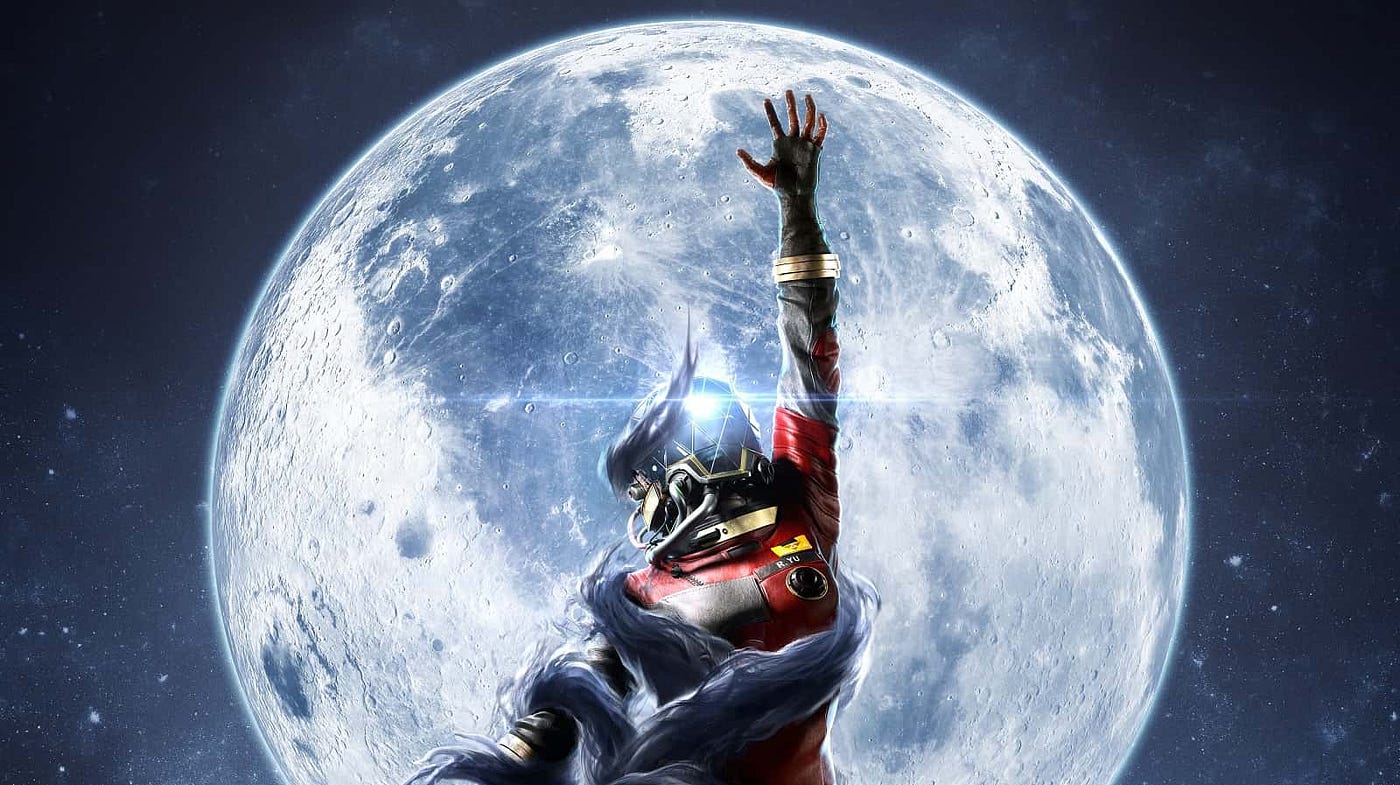
A notable exception of this being Mooncrash (Arkane Studios, 2018), a downloadable content for Prey (2017). The base game was intended as a spiritual successor to the System Shock series, an excellent game in its own right, that again wanted to create emergence through options, but similar to other games using this method, their most emergent moments were during the starting hours, when the player is still weak and has limited resources. Overtime as the arsenal and powers increases, emergence can still be present, but it is not so strongly encouraged by the systems.
Put simply, it is always easier and faster to just shoot things in the face than trying to use the environment and unconventional weapons in smart and creative ways. If traditional aggressive methods are viable, the player is being indirectly discouraged from using other more elaborate but mechanically interesting strategies.
With Mooncrash, Arkane changed its approach and re-purposed the systems from the base game to create a tightly designed roguelite focused entirely around player limitation, planning and improvisation.
In this game you control various characters but it's not about choosing the one you like, you must play with all of them to complete the game, each with its own pre-determined archetype, meaning not only you can't be a jack-of-all-trades (by far the least interesting way to play these games in my opinion) it also forces you to utilize play styles you may not be used to or didn't experience when playing the base game, potentially taking the player out of their comfort zone in a mechanically interesting way. You have to explore and approach enemy encounters differently depending on the character which also adds variety, since not everyone can learn alien powers or knows how to hack computers or repair bots. This means you also need to gather items carefully, since for example you shouldn't grab precious shotgun shells for a character that doesn't even use firearms. You need to leave items for later runs when they might be more useful instead of mindlessly hoarding everything you find.
But even exploration is based around limitation. Brilliantly, Mooncrash introduces a time-based element to exploration in the form of a corruption meter, that keeps making the game harder the more you play by adding stronger enemies and environmental hazards. I understand why some people didn't like this inclusion. Those who, like me, enjoy taking their sweet time exploring every corner of the levels to make sure they don't miss anything may feel too pressured and overwhelmed by the time limit. And you do have plenty of time to explore, but I can see how just by having time as a factor would create some friction with certain players. However, without it you would remove one of the most crucial elements in the game, planning.
Much like other roguelites, this game is structured in separate runs. In this case, you advance until you run out of time, die or find a way to escape the Moon station. You have to do it with all 5 characters consecutively. The corruption meter persists during these runs and keeps increasing so you're required to make important decisions. Where do I want to go with each character? Which objectives do I want to complete? How much do I want -or can afford- to explore each area? But not just that, because like I said, equally important to planning is improvisation. You should plan ahead, but also be able to think on your feet when plans go wrong: The Moon Shark was a complete dick and made me lose a lot of time getting to the Crew Annex. I'm also close to max corruption level, which will reset all my progress, so I have to forget about exploring and cut straight to the objective as fast as I can. No exploration means I don't have that much ammo left either but there's a Weaver in the next room and I don't know if I'll be able to avoid it because the objective is right there.
This game is full of tension, tough choices and sacrifices that simply can't exist in a game designed around options that empower the player. And it's all purely emergent, you and the dynamic systems interacting with each other and nothing more. This example is important for this topic, because it's exploring an interesting way to design imsims by applying principles from other games to it, which was the whole point of this piece.
Tools for Emergence
Partially inspired by Mooncrash, I wanted to consider some other existing elements that, similar to using roguelite as inspiration, also have great potential to innovate and create new and exciting possibilities for emergent gameplay and/or narrative. Notice how all of them follow the same principle I mentioned earlier, in reducing the direct agency of game creators and instead creating systems that simulate on their own.
And it may sound obvious but just in case, that doesn't mean all games should have all or any of these elements, this is at the very least just for consideration.
Physics
This one is a given I assume, but physics, as present as they are in current games tend to be used as visual effects for realism or as minor mechanical additions with little importance, but rarely as a core element of gameplay. In the mid-2000, as engines were starting to be able to simulate complex physics in real time, games like Half-Life 2 (Valve Corporation, 2004) or Dark Messiah of Might and Magic (Arkane Studios, 2006) began exploring the possibilities of physics as an important game mechanic. Particularly in the latter game, the results were extremely promising but after that, perhaps shaped by the seventh generation of consoles, physics eventually became reduced to mostly eye candy with little to no gameplay relevance.
But they are a tremendous tool, the previously mentioned Breath of the Wild being just a recent example. Physics have a huge potential for creating process-driven situations with only the player and/or the dynamic systems acting as the catalyst with no designer determining the exact outcome with rigid pre-determined data, with perhaps the most extreme example recently being the "every pixel is physically simulated" roguelite Noita (Nolla Games, 2019).
And speaking of Noita, let's not forget about fluid simulation, now only used sparingly and too expensive to design as a complex game mechanic in 3D, but in a not too distant future it will surely be an impressive feature.
Multiplayer
Yeah multiplayer. I'm a single player person myself, but there's so much we can do there. We've already been observing for years the amazingly large-scale narrative emergence in games like EVE Online (CCP Games, 2003) with massive wars being fought with enormous in-game economic and political motivations and consequences as factions ally and fight one another much like real life wars. And none of that is designed, it's just people interacting with the systems. But we don't even need to go to extreme cases, even survival games like Rust (Facepunch Studios, 2018) offer a small-scale emergence of constant player-driven struggles as you scavenge, get ambushed by other players or raid other people's properties.
However, I'm personally more interested in coop experiences. Both from a narrative point of view but also for designing emergent mechanics entirely around working together with other people. More often than not coop feels a bit like an afterthought, of two users playing almost the exact same way they would if they played alone with perhaps only a few minor additions like resurrecting each other and little more. There are games like Army of Two and Army of Two: The 40th Day (EA Montréal, 2008/2010), that even if they were mechanically rigid, they were specifically designed for coop to create an experience that couldn't exist playing alone. This is what I want to see, but also integrating emergent mechanics requiring cooperation into the core gameplay.
Social Games
Hold on please don't close the tab just yet, hear me out. I'm not necessarily talking about so-called casual games or Facebook games or whatever. This is more of a subsection about the multiplayer games I mentioned before, but more directly connected to emergent narrative in the context of game communities. This was already present in early MMOs like Ultima Online (Origin Systems, 1997) or the already mentioned EVE Online, but to put a more recent, less destructive example, games like Minecraft (Mojang AB, 2011) when played in multiplayer with public servers -I'd almost say accidentally- encourages the creation of communities and somewhat organized cooperation. Again this isn't too different from what I was saying about coop games before, but there's an important distinction here where you're not just playing with a couple of friends to do certain tasks in order to advance the game, instead you're "living" with dozens of other players, most probably strangers who you might get to know eventually but the cooperation is more vague towards a long term undefined goal of simply maintaining a stable community.
Procedural Animations
Yes, I'm thinking of Trespasser (DreamWorks Interactive, 1998). Procedural or even semi-procedural animation in games means, in the case of NPCs that the movement doesn't depend on rigid state machines with specific animations assigned, but instead the AI decides how to move the actor based on the environment and events around them through the use of physics. Of course, there's a reason why its use is almost non-existent in recent games with few exceptions like Rain World (Videocult, 2017), but as technology keeps improving there's an incredible world of gameplay possibilities that open with this. This prototype made by MakJune being proof of it:
Voxels and Deformable Meshes
Now a relatively common element of many games, like Minecraft in the case of voxels or Astroneer (System Era Softworks, 2016) for deformable meshes. Surely I don't need to explain the benefits of modifying and adapting the environment when it comes to player expression and sandbox gameplay, but there can be many emergent implementations of this that not necessarily need to stay within the open-world survival genre, particularly when physics and other simulated elements play a part. Gladly, you don't need to take my word for it, as games like Teardown (Tuxedo Labs, 2020), a heist game made entirely from destructible voxel levels already shows how powerful this technology can be when designed with dynamic complex systems in which the environment is a direct obstacle and an integral part of the core gameplay.
Simulated NPCs (or Autonomous Agents)
Again, we already have examples of this in games, like the complex pedestrian simulation in a game like Grand Theft Auto IV (Rockstar Games, 2008) but they're not a part of the core gameplay structure and interaction with them is very limited outside of violent actions.
Similarly games like The Elder Scrolls series (Bethesda Softworks, 1994–2011) and Kingdom Come: Deliverance (Warhorse Studios, 2018) give them a much more interactive simulation and important role to them, but that's not the only way to integrate NPC simulation into the gameplay.
To put a relatively simple example Dungeon Keeper II (Bullfrog Productions, 1999) approached the RTS genre differently by instead of treating units like mindless pawns at your disposal like in most RTS, they were actual independent individuals with their own routines, jobs and preferences and all you could do at best was "kindly suggest" them to do certain things or move them to a specific location, but generally they were quite capable on their own to do what was needed. You felt more like an administrator and supervisor of real creatures living inside your dungeon rather than an omnipresent mastermind controlling every single action made by your units, which even when using the possession skill, it was limited to just one unit for a short amount of time.
But even then you could say it's not really the core of the gameplay and simply an important element, so to put an example of one in which it is, Waking Mars (Tiger Style, 2012) is a fantastic game about creating dynamic, self sustainable ecosystems within Mars' underground caves. The player, as a lone explorer needs to create the catalyst for the ecosystem to re-activate, but after that point, it will continue to grow on its own and all the player needs to do is make sure it is balanced and stable in the long run by ensuring a minimum amount of biomass is present. There have to be enough plants so herbivore population can thrive, but there need to be predators to keep them in line too. The animals feed, reproduce, hunt, are hunted and die on their own and that same simulation is the main mechanic of the game.
But it doesn't have to be either a core element of the gameplay or just a tool for immersion. Resident Evil 2 Remake (Capcom Co Ltd, 2019) implemented an extremely powerful enemy called "Mr. X" who wanders around the environment freely searching for you, making it feel like a living entity instead of a hand-placed obstacle, you never know when or where it will appear. It goes without saying that the audience's response to its inclusion was overwhelmingly positive and possibly the highlight of the game by the majority of players.
System Randomization
There's a legitimate concern among developers that the now common use of procedural elements specially when it comes to environment generation diminishes the designer-curated experience in which pacing, variety, balance or even a certain feel of craftsmanship are present. I am however, more interested in individual randomized elements that create unique experiences and maintain a balance of random and static, for example handcrafted worlds filled with simulated elements. To mention Mooncrash again, that game had static levels, but it was environmental hazards, enemies, loot, etc that was randomized to some degree between simulations. Many games have implemented pre-written events that occur at random times and places, particularly in open-world games such as Red Dead Redemption (Rockstar Games, 2010). Sometimes they're only to bring some life to the world, others in the form of sidequests, but I'd like to see random or semi-random encounters like these play a bigger role in the gameplay, to create unexpected situations that can create wonderful emergence like the sudden, non-scripted appearance of vastly stronger enemies in the middle of a fight like in Resident Evil 2 Remake or even Monster Hunter: World (Capcom Co Ltd, 2018) forcing the player to adapt and improvise. Randomization can also be done by limiting the player somehow, like your weapon jamming in Far Cry 2 (Ubisoft Montreal, 2008). I'd be careful implementing systems like these however, players don't often respond to them positively unless it offers something meaningful in return.
Similarly, trying to expand the concept from Mount & Blade: Warband, it can also be used in a purely narrative aspect, with characters having different traits, goals, locations, etc in each playthrough, changing in return their disposition to the player, but also towards other characters.
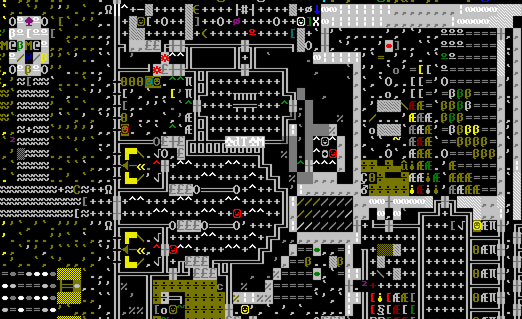
But I want to give perspective with different implementations so why leave it at just randomizing some elements when designers could instead abandon all delusions of control and simulate absolutely everything to the most absurdly and obsessively detailed emergence imaginable? When it comes to extremes in random generation, nothing beats Slaves to Armok: God of Blood Chapter II: Dwarf Fortress also known as Dwarf Fortress (Bay12 Games, 2006). I was going to describe some of the emergent situations that can appear in the game, but nothing I would write could possibly make justice to the sheer insanity that this game is, so I'll just leave a screenshot.
Virtual Reality
VR is incredible. I know a lot of people frown or directly yawn at the mention of VR, I know I did at first (as a former VR developer myself) but now, seeing the state of the technology, I don't think there's anything else that has more potential for emergent gameplay than VR.
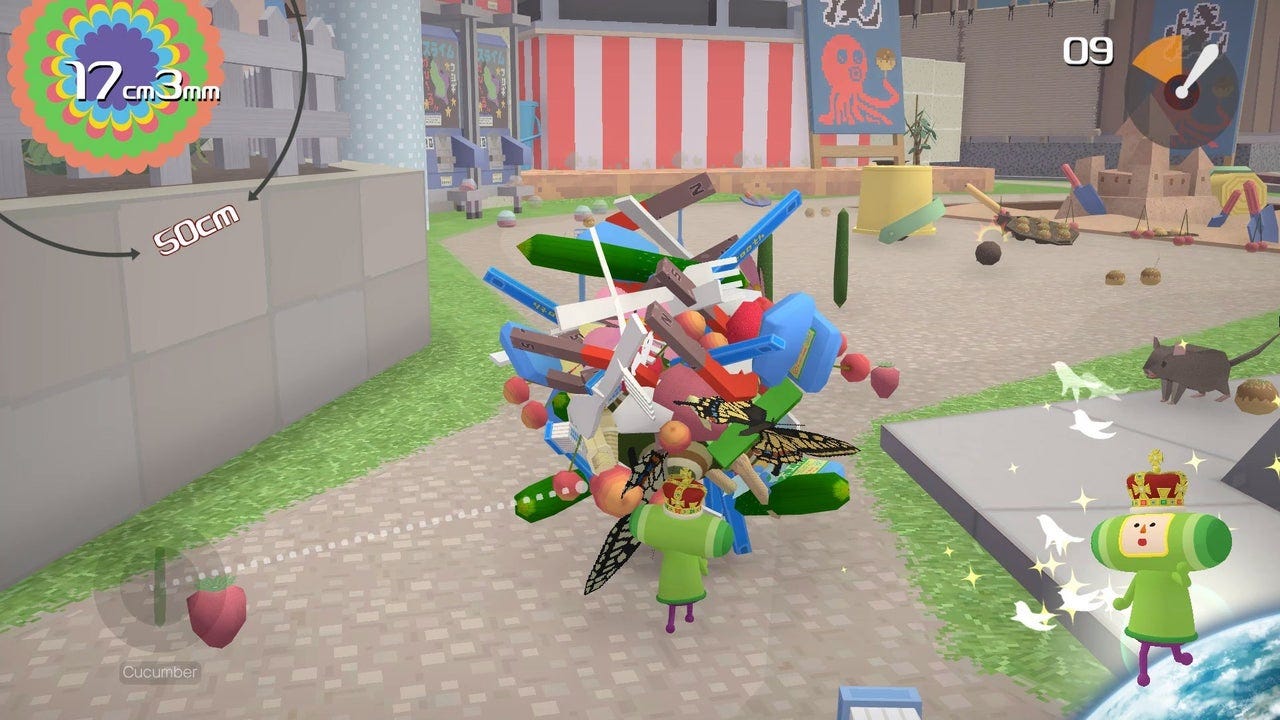
We often see VR and immediately think about the immersion, about being there. However, even if that's really cool, the part I'm most interested in is input. Our means to play determine the games that are made. The controllers themselves determine how games are designed. An extreme case would be games like Katamari Damacy (Namco Ltd., 2005), that only make sense in the context of playing with a double joystick controller representing each of the players' hands pushing the katamari (the ball). But it can also play a more subtle influence, like how in Dark Souls (From Software, 2011) the controller layout used the bumpers and triggers of each side for actions on their corresponding hands, like right bumper to attack with right hand, left trigger to parry with left hand. Because of this, if played with anything other than a traditional console controller, like a keyboard and mouse -while possible- is missing the intended experience and feel created by the designers. Other methods of input like touch screens or Wiimote have likewise created unique mechanics with those specific controllers in mind.
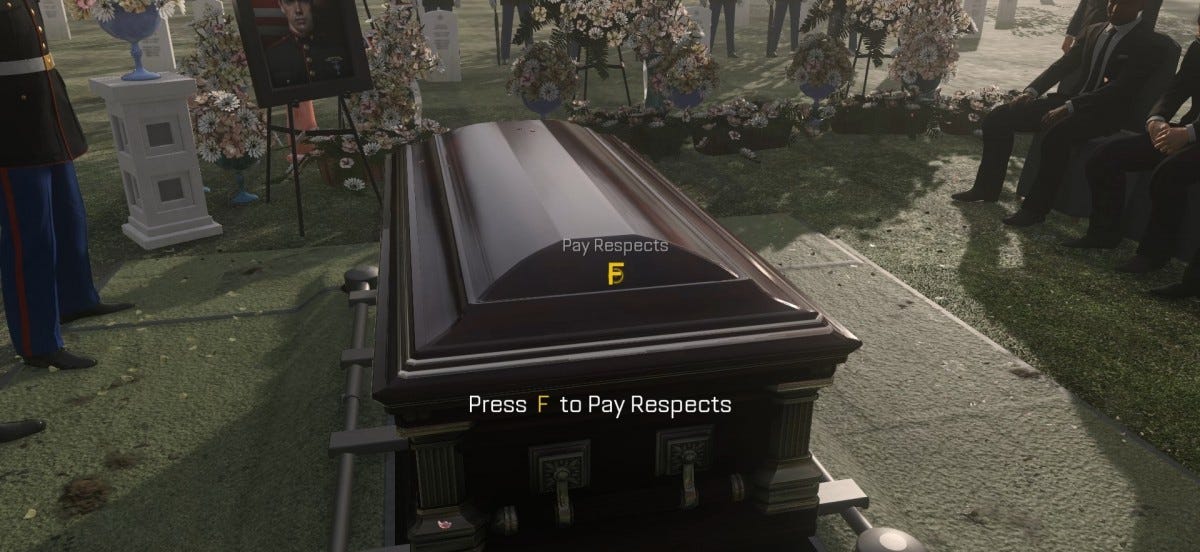
VR introduces new methods of input and that by itself is already good because it means new games that weren't possible before. But what's most important is the type of input it introduces. With head tracking being one of them, but hand tracking being the most interesting to me. You could argue it can also exist outside of VR, but I think much would be lost along the way. To put a generic and not necessarily accurate example, in a traditional modern First Person Shooter you press R to reload. In a VR FPS there is no reload button. You reload yourself manually. It's an analog input, not a button for a specific action that does everything for you. You don't press F to pick up the box and then move the mouse to rotate it, you manually do all of those things with your own hands.
I don't know about other people, but traditional controllers, from keyboard and mouse to console controllers sometimes feel claustrophobic. The imposition of having to design everything within a short amount of rigid inputs for abstract actions leaves little to no room for subtle or minor actions, for in betweens, for personal expression, non-verbal communication, etc. It all needs to be clearly defined in differentiated actions that serve either very specific purposes(reload button) or generic and contextual ones (interact button).
To go back to imsims I think they have often struggled with input. The Underworld games are an example of simulations that were constantly fighting the limitations of the inputs. The level of interaction was deep, but it required entering in different abstract states like "Look", "Grab, "Talk" or "Use" similar to classic graphic adventures. But for more action oriented and immersive games this was very awkward and unnatural way to interact with the world and later games would just remove some of these options or make them contextual, which made it more comfortable to play, but also removed some of the depth and freedom, just like with the establishment of mouselook as the standard method of interaction. There was something almost organic about using the mouse cursor as a representation of your hand moving through the physical space like it was also used in Arx Fatalis (Arkane Studios, 2002).
Thanks to VR and its controller, this way of interaction has returned, but far deeper and more responsive, tracking not only hand position and rotation but even detecting each finger. There's a huge potential for extremely complex and reactive interactions here, with games like Boneworks (Stress Level Zero, 2019) being just a taste of what's to come. There's of course some other issues like technical limitations and affordability that VR still needs to solve before it becomes a stable platform, but I'm convinced that a significant part of the innovation of immersive sims and emergent game systems in general will happen within VR.
Some Cool Links
On emergent gameplay:
·Practical Techniques for Implementing Emergent Gameplay by Randy Smith and Harvey Smith.
On emergent narrative:
·Narrative Lego by Ken Levine
On LGS' design philosophy and history:
·GAMBIT Looking Glass Studios Interview Series
On design through options vs design through limitations:
·Practical Game Analysis (applied to Thief and Deus Ex) by Warren Spector and Doug Church
·Looking Glass Studios Interview Series — Audio Podcast 8 — Marc "Mahk" LeBlanc
·Just fucking play Mooncrash
Core Of Emergence In Game Design
Source: https://medium.com/@eric.juvi/tools-for-creating-emergence-in-narrative-and-game-design-e803b72104c4
Posted by: brownuppon1941.blogspot.com
0 Response to "Core Of Emergence In Game Design"
Post a Comment